What Other Fruiting Trees Are in Mulberry Family
-Artocarpus altilis: Breadfruit
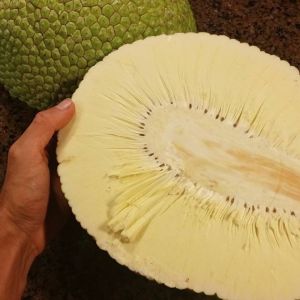
I recollect of breadfruit every bit roughly equivalent to a spud that grows on a tree. The fruit is not well suited to eating as a fresh/raw food, but cooked information technology is an outstanding starchy nutrient that can be used in many of the aforementioned ways as potatoes: roasted, fried, mashed, etc.
The breadfruit tree is a tremendously productive nutrient establish, with some of the highest yields per hectare of whatsoever starchy ingather.
Breadfruit grows throughout the lowland areas of the wet tropics. It is cold sensitive, and does not like to even get close to the freezing point. In Florida, for many years breadfruit trees were restricted to the Keys, the isle chain off the southern role of the peninsula where winter low temperatures are buffered by the surrounding water. In recent years, a string of mild winters has enabled breadfruit copse to produce fruit in the southeastern part of the peninsula.
Breadfruit is native to Southeast Asia. It was ane of the "canoe plants" which the Polynesians carried with them as they colonized islands across the Pacific.
Some forms of breadfruit are seedless; some have seeds which are edible when cooked, resembling chestnuts in flavor and texture.
-Artocarpus anisophyllus: Entawak or Mentawa
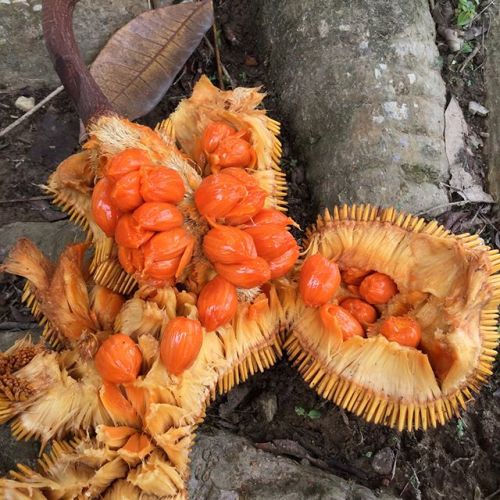
Entawak fruits are smaller than those of many fruits in the Artocarpus genus, only virtually eight-11cm (3-4 inches) in diameter, with a spiky trounce surrounding bulbs of intensely red-colored flesh around the seeds. People report the season is excellent, very intense and sugariness, tasting a bit like baked pumpkin with wheatgrass juice.
Native to Borneo, Sumatra, and peninsular Malaysia. Common names are bintawak, bintawa, entawak, and mentawa. Extremely rare even where it does abound – Rare fruit hunter Fit Shortie reported that in Sekadau, Borneo, she and her partner Simon asked every durian seller if they knew of this fruit, and finally one of them said he knew of a tree xx kilometers away, deeper into the jungle. They traveled the altitude to the reported location, where they met a ten-year-onetime who led them to the tree, climbed the 30 meter (90 foot) alpine tree and cut fruits for them. She said the taste was "meliorate than any terap, intensely sugariness, you tin literally gustatory modality the colour."
Very tropical, just grows in the lowland equatorial tropics, cannot survive temperatures below 50 F (10C).
-Artocarpus heterophilus/integrifolia: Jackfruit
Jackfruit is i of my favorite fruits, with an aroma and flavor that are just crazy-tropical, an astonishing symphony of aromas and flavors.
Jackfruit is the globe's largest fruit that grows on a tree. A single jackfruit can weigh as much as 35 kilograms (80 pounds). Since tree branches might break under the weight of such a load, jackfruits often abound right out of the body of the tree.
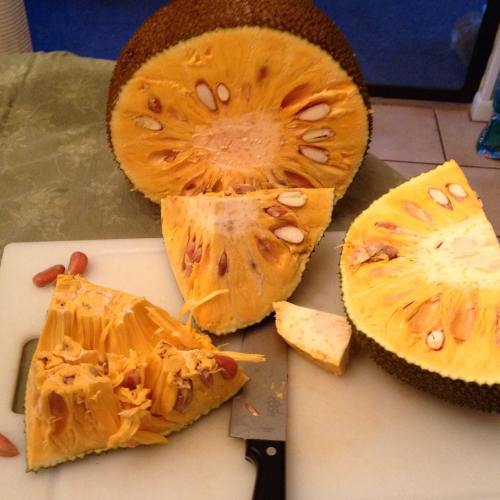
The construction of a jackfruit consists of fruity mankind and seeds surrounding an inedible central core that runs from the stem upward through the heart of the fruit. The fruity flesh occurs as a jacket of flesh, or bulb, surrounding each seed – those jackets of flesh are the edible part. There are also stringy fibrous tissues running between the jackets of flesh, collectively called the "rag". In some varieties, the rag is stringy and inedible, in others it's sweet, fleshy, and delicious.
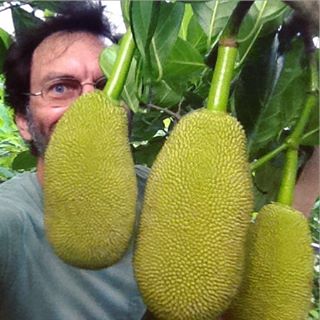
Jackfruits can exist eaten in 2 ways: immature or mature. Young jackfruits are cut from the tree before they accept started developing whatever sugariness or fruity flavors. At this stage, they don't have a lot of flavor, but they have a pleasant texture, and are used as a vegetable, making a good vegan meat substitute for cooking in tacos and "pulled pork" sandwiches. But left on the tree to maturity, jackfruits develop sweetness and an intense of flavors, making them one of the earth's summit dessert fruits. In recent years, young jackfruit used every bit a vegetable has exploded in popularity. This is a corking evolution, making use of an outstanding sustainable tree crop in healthful, found-based foods. Simply one side issue is that millions of people now think that jackfruit is merely that stuff used as a sandwich filling, and they don't realize the other form of jackfruit exists: the mature fruit, an astonishing fruity delicacy.
Jackfruit trees vary considerably in the flavors of fruit they produce. Ane jackfruit tree I know of in South Florida has fruits which gustation like an orange creamsicle, combining jackfruit'south usual symphony of tropical aromas & flavors with a powerful citrusy-orange taste, balanced on meridian of a rich, cream-similar texture. This is one of those jackfruits where not but are the jackets of flesh around the seeds deliciously edible, merely so is the rag, the strings of flesh between those jackets of mankind. (Although the rag is still kind of fibrous, and I spit out the fibrous bits once I've sucked all the wonderful orange-cream mankind off them.)
It'due south possible to make a fantastic jackfruit-flavored soft-serve ice cream, from nothing but jackfruit. Just freeze the jackfruit segments, and run them through a Champion juicer. That automobile gives the resulting "nice cream" the most amazingly rich, creamy mouth-feel, featuring the total jackfruit season explosion with no added oils at all. This technique also works great with mango, banana, and mamey sapote, to make dairy-costless, oil-free, soft-serve tropical fruit nice cream.
Jackfruit copse grow in hot, humid tropical climates, into moisture areas of the subtropics. When mature, they can handle light frost with minimal damage. They grow and fruit well in Due south Florida.
-Artocarpus hypargyraeus: Kwai Muk
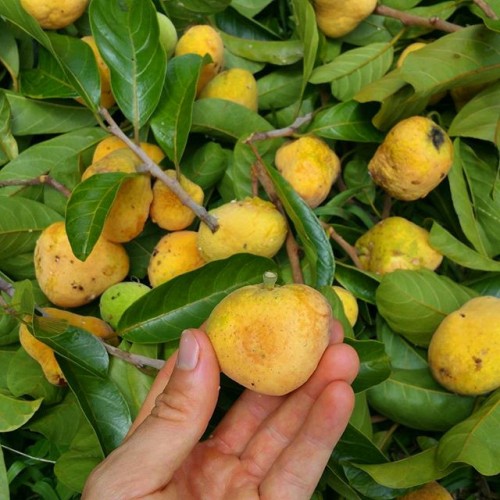
Kwai muk is ane of the smaller-fruited members of the Artocarpus genus, with fruits nearly 1 to inches (2.5 – 5 cm) in diameter.
Kwai muk fruits reportedly vary considerably from one tree to another, with some copse producing excellent fruit. I've merely had them from one tree, which had a creamy flavor and a pleasant, strawberry-similar flavour.
I've heard other people report detecting flavors in kwai muk that remind them of mango, apricot, jackfruit, grapefuit, fig, and guava.
The tree is somewhat smaller than many of its Artocarpus cousins, reaching about fifteen-25 feet (5 – 8 m) tall. The tree reportedly tin handle light frosts, unlike many of the members of this genus, which don't like temperatures that get anywhere close to freezing.
-Artocarpus integer: Champedak/Cempedak/Tibadak
Adept champedak is rated among the globe's best fruits, co-ordinate to people who accept tasted this rare fruit, which is native to Southeast Asia. Plainly at that place are mediocre varieties of champedak out there, simply people written report that the all-time ones have durian-like flavors and aromas, a creamy texture, and are super-sweet. Some of the flavors people report detecting are orange sherbet, bubble gum and salted caramel.
Champedak is a cousin of jackfruit with roughly the aforementioned fruit structure – a central core, surrounded by seeds encased in jackets of sugariness edible flesh, with a rough-skinned rind surrounding the whole thing. The rind appears more loosely attached than in jackfruit, and people usually peel off the rind to betrayal the edible portion within.
Rare fruit hunter Fit Shortie rates chempedak as her favorite sweetness fruit in the world. It's lots of fun reading her super-enthusiastic posts nearly this fruit. Hither are a few of her quotes virtually champedak (also spelled cempedak):
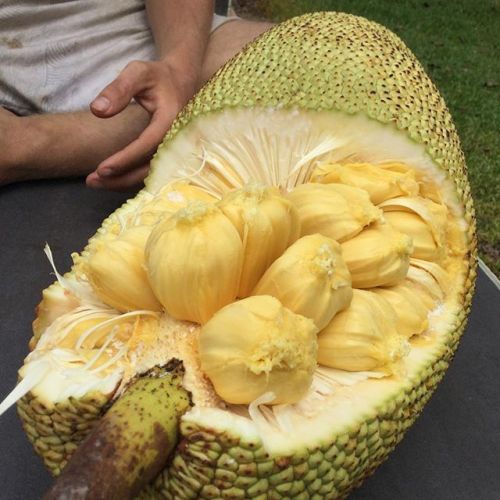
Champajack is a hybrid between two great fruits – champedak (Artocarpus integer) and jackfruit (Artocarpus heterophylla). Taste reportedly is phenomenal. Photograph past Fit Shortie.
"The cempedak is my number one sweet fruit. Salted caramel ice cream flavor…. They are beyond durian. Insane quality of fruit. It was so SWEET the aftertaste of each pod, the caramel sugar edge would just burn into our tastebuds, while the orangish goo would drip from our lips. Nosotros were but sitting at that place… shaking our heads in disbelief, thinking this is only besides sweet. How does this 'best fruit in the world' taste similar? This is how I explain information technology – if durian and jackfruit had a infant – it would be cempedak."
There is a lot of variation from tree to tree amid champedaks. Some have mankind that's whitish-yellow, while in some the mankind is closer to orange in color. Champedak trees are more cold-sensitive than jackfruit trees, thriving only in rainy equatorial climates.
-Artocarpus odoratissumus: Marang/Tarap
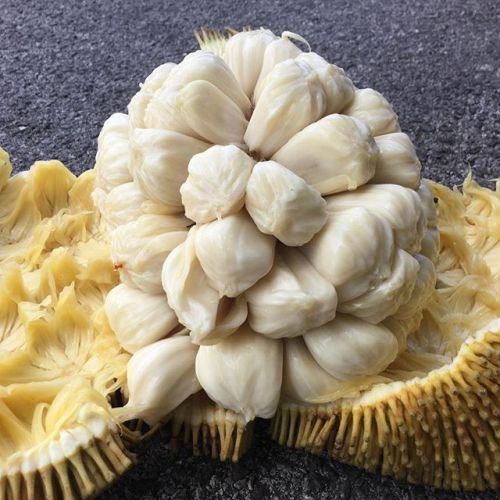
This is some other large Artocarpus fruit packed with sweet fruity-tasting pods of flesh effectually the seeds. The best cultivars reportedly taste like vanilla lime marshmallows with a hint of tangerine, and a soft texture that dissolves on the tongue. Other flavors people written report are assistant, melon, and cinnamon.
Called tarap in Borneo, marang in the Philippines, this is a powerfully scented fruit. Some forms odour pleasant (at least to exotic fruit lovers), while in other forms of marang the smell is unpleasant, reminding people of the smell of diesel fuel.
Rare fruit hunter Fit Shortie gives a starting time-hand written report on this species: "Not all marangs are the same. Some have big pods, some accept hundreds of narrow pods, some have underdeveloped pods in the mix. Some are packed with pods, some are not. The shape & volume does not seem to affect the taste – we've had not bad ones no matter the construction. Their taste can vary between uber-sweet vanilla marshmallow and sweet, fresh limey marshmallows, I honey the limey ones. The scent of the marang is way more intense than durian for me right now, I tin can aroma a marang hidden at the bottom of somebody's truck from the other end of the fruit market place. I can scent a marang tree while nosotros drive by on the motorbike at full speed."
Marang is an ultra-tropical tree, thriving only in rainy lowland areas near the equator. It doesn't like temperatures that dip anywhere close to frost. Reportedly the all-time forms of this species grow on the isle of Mindanao, in the southern Philippines.
-Artocarpus sericicarpus: Pedalai
Pedalai (Artocarpus sericicarpus) has been described as "the Holy Grail of Borneo fruits" for its outstanding eating qualities. Photo by Fit Shortie.
Pedalai (Artocarpus sericicarpus) has been described as "the Holy Grail of Borneo fruits" for its outstanding eating qualities. The Rare Fruit Council of Australia reports that the flavor of pedalai is superior even to that of marang (Artocarpus odoratissimus), and they recommend this fruit tree for widespread planting in the tropics. 1 written report says pedalai has a flavor reminiscent of "overcooked sweet pumpkin with fruity juiciness", another describes it as having a "creamy vanilla flavor'.
Pedalai is another Artocarpus with a bumpy, knobby rind, underneath which jackets of sweet flesh environs the seeds. Fruits are effectually 15 cm (6 inches) in diameter, turning orange when ripe, and sometimes with fibrous projections from the rind that can give it the appearance of a giant rambutan fruit. Different marang, the fruits have little aroma. The seeds of pedalai, like other Artocarpus, are edible when cooked – reportedly afterward a brief frying in oil, they taste like peanuts.
-Ficus carica: Mutual Fig
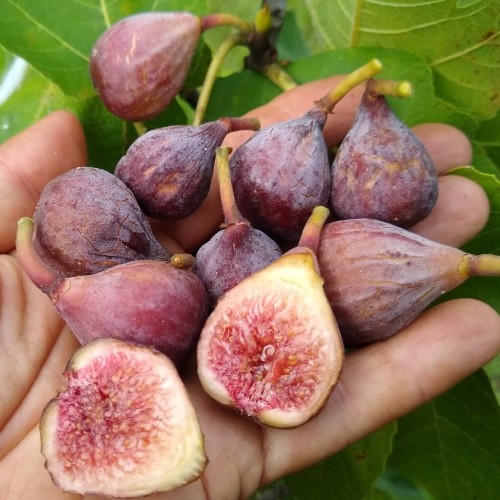
Fresh figs have a wonderful sweet fruity flavor, and a melting soft texture. In the United states of america, many people have just eating figs dried, or every bit the pasty filling in a Fig Newton, and take never experienced the lusciousness of the fruit in its fresh form. If yous live in a climate zone where fig trees abound, try to find a place where yous tin eat them direct off the tree (similar I'm doing in this pic), or become some at a farmers market. If you lot're outside of fig country, sentry your produce department for imported figs. Fifty-fifty if you lot're in an area with icy cold winters, there's a chance someone might take a fig tree around and will share some fresh fruits with you. The Italian gardeners of New York and Chicago are legendary for the heroic efforts they go through to protect their fig trees, even burying the trees in a trench each winter and raising them out of the ground each leap. (Yes, fresh figs are that adept.) If you harvest figs off the tree, be aware that the all-time figs tin sometimes look to a novice similar they're a little past-peak. Slight cracks develop on the skin of some varieties, and the fruit droops slightly – those are the signs that a fig is at the peak of succulent ripeness.
Figs are loaded with health-promoting antioxidants. And here's something actually interesting: researchers who tested six dissimilar varieties of fig confirmed something I'd suspected: the darker varieties of fig take higher levels of antioxidants. "Color appearance of fig extract correlated well with total polyphenols, flavonoids, anthocyanins, and antioxidant chapters. Extracts of darker varieties showed higher contents of phytochemicals compared to lighter colored varieties." I've been trying to collect dark-regal fruited varieties of fig, looks like I'1000 on the right track with that. One of the main antioxidants in figs is antirrhinin, the highly-touted nutrient that's also present in acai and black currants.
Figs are more than just succulent – they may have been the first crop humans always cultivated. Archaeologists accept discovered the remains of an evidently domesticated form of fig at a site from 9300 BC. That's a thousand years before the domestication of wheat, barley, and peas, which are ordinarily considered humans' first crops.
Fig copse grow all-time in Mediterranean climate zones, just tin produce at to the lowest degree some fruit in the subtropics, tropics, and fifty-fifty the warmer parts of warm temperate zones.
-Morus spp.: Mulberries
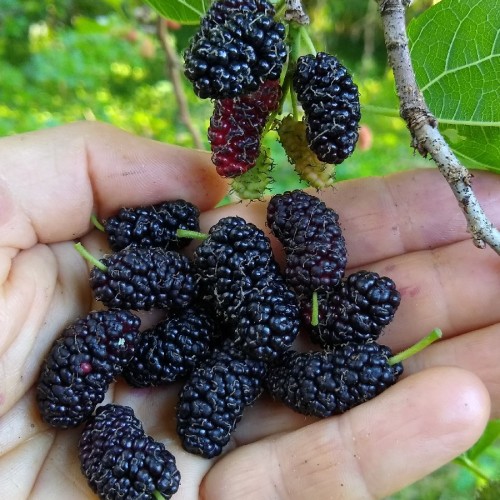
Mulberries are sweet and delicious, and this is fruit with one of the widest distributions of any that I know of: there are forms of mulberries that will grow in climates all the way from the equatorial tropics to regions with snowy, common cold winters.
Mulberries are packed with healthful anthocyanin pigments, which reportedly help prevent cancer and inflammation. At to the lowest degree one report plant that mulberry anthocyanin extracts prevented the evolution of diabetes in animals prone to the disease.
Finding very early and late varieties is something where a group attempt can benefit u.s. all, so we tin all enjoy the longest possible flavour of anthocyanin-packed mulberries. Do you know of whatsoever especially early or belatedly-fruiting mulberry trees?
"Himalayan" is the best-tasting mulberry I've ever eaten (and I've eaten a lot of really tasty mulberries). The berries are iii inches (7.5cm) long – the aforementioned dimensions as my pinky finger.
In the US, many people have never eaten a mulberry, and only know this fruit from a nursery rhyme about a 'mulberry bush'. Which is a crazy state of affairs, because this is a delicious, productive fruit tree (not a bush-league) that'due south super-like shooting fish in a barrel to grow over most of the United states of america. Kids and adults love eating these fruits.
Back in the spring of 2004, my friends and I establish a mulberry tree growing in Gainesville, loaded with an incredibly arable crop of big, flavorful berries. The tree made like crops in subsequent years, and was clearly a superior fruiting variety. We started propagating plants by rooting cuttings from this tree, and we distributed the young mulberry trees at farmers markets and festivals through our volunteer group, the Edible Plant Projection (forth with many other food-producing plants). The original mulberry tree was growing on NW Sixth Street in Gainesville, then nosotros named the variety "Sixth Street" mulberry. As a outcome of our efforts, there are now many hundreds, perchance over a thousand, "Sixth Street" mulberry trees fruiting all over the southeastern United States every spring. That's how information technology works: detect superior varieties of fruit trees, propagate them, and distribute.
Other tree crops in the Moracaeae:
-Brosium alicastrum, Mayan breadnut
-Brosimum galactodendron, cow tree
-Maclura tricuspidata, che
-Treculia africana: African Breadnut
mceachernmays1958.blogspot.com
Source: https://floridafruitgeek.com/moraceae-the-mulberry-family/
0 Response to "What Other Fruiting Trees Are in Mulberry Family"
Post a Comment