Tree of Life Cut Out With Family Name

Instance of a family tree. Reading left to correct Lucas Gray is the father of three children, the grandfather of five grandchildren and the great-grandfather of iii siblings Joseph, John and Laura Wetter.
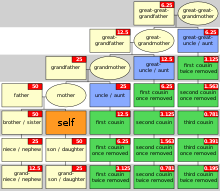
Family unit tree showing the relationship of each person to the orange person, including cousins and cistron share
A family tree, also called a genealogy or a pedigree chart, is a chart representing family unit relationships in a conventional tree structure. More detailed family trees, equally used in medicine and social work, are known equally genograms.
Representations of family history [edit]
Genealogical data can be represented in several formats, for example, every bit a pedigree or ancestry chart . Family trees are often presented with the oldest generations at the top of the tree and the younger generations at the bottom. An ancestry chart, which is a tree showing the ancestors of an private and not all members of a family unit, will more closely resemble a tree in shape, being wider at the pinnacle than at the bottom. In some ancestry charts, an individual appears on the left and his or her ancestors appear to the right. Conversely, a descendant nautical chart, which depicts all the descendants of an individual, will be narrowest at the peak. Beyond these formats, some family trees might include all members of a item surname (e.yard., male-line descendants). Yet another approach is to include all holders of a certain office, such as the Kings of Germany, which represents the reliance on marriage to link dynasties together.
The passage of time tin can also be included to illustrate beginnings and descent. A time scale is oftentimes used, expanding radially across the center, divided into decades. Children of the parent form branches effectually the eye and their names are plotted in their birth year on the time scale. Spouses' names join children's names and nuclear families of parents and children branch off to grandchildren, and so on. Great-grandparents are oft in the heart to portray four or five generations, which reverberate the natural growth pattern of a tree every bit seen from the top. In a descendant tree, living relatives are common on the outer branches and contemporary cousins appear next to each other. Privacy should be considered when preparing a living family tree.[ citation needed ]
The image of the tree probably originated with that of the Tree of Jesse in medieval art,[one] used to illustrate the Genealogy of Christ in terms of a prophecy of Isaiah (Isaiah xi:1). Maybe the starting time non-biblical use, and the first to bear witness full family unit relationships rather than a purely patrilineal scheme, was that involving family trees of the classical gods in Boccaccio's Genealogia Deorum Gentilium ("On the Genealogy of the Gods of the Gentiles"), whose start version dates to 1360.[two]
Common formats [edit]
In add-on to familiar representations of family history and genealogy as a tree structure, there are other notable systems used to illustrate and document beginnings and descent.
Ahnentafel [edit]

An Ahnentafel (High german for "ancestor table") is a genealogical numbering arrangement for listing a person's direct ancestors in a stock-still sequence of ascension:
- Subject area (or proband)
- Father
- Mother
- Paternal gramps
- Paternal grandmother
- Maternal grandad
- Maternal grandmother
and so on, dorsum through the generations. Autonomously from the subject or proband, who can be male or female, all fifty-fifty-numbered persons are male, and all odd-numbered persons are female. In this scheme, the number of whatever person's father is double the person's number, and a person's mother is double the person's number plus ane. This organization can too be displayed as a tree:

| 4. Paternal gramps | |||||||||||
| 2. Father | |||||||||||
| 5. Paternal grandmother | |||||||||||
| 1 Subject (or proband) | |||||||||||
| vi. Maternal grandfather | |||||||||||
| 3. Mother | |||||||||||
| seven. Maternal grandmother | |||||||||||
Fan chart [edit]

Screenshot of Gramps (v. five.0.1) displaying a fan nautical chart and the Given proper name deject gramplet on the bottom.
A fan chart features a half circle chart with concentric rings: the subject is the inner circle, the second circle is divided in two (each side is one parent), the third circle is divided in four, and so forth. Fan charts depict paternal and maternal ancestors.
Graph theory [edit]
While family trees are depicted every bit trees, family unit relations do not in general course a tree in the strict sense used in graph theory, since distant relatives can mate. Therefore, a person tin can have a common ancestor on both their mother's and father'south side. All the same, because a parent must be born before their kid, an individual cannot be their own antecedent, and thus there are no loops. In this regard, ancestry forms a directed acyclic graph. Nevertheless, graphs depicting matrilineal descent (female parent-daughter relationships) and patrilineal descent (father-son relationships) do form trees. Assuming no mutual ancestor, an ancestry chart is a perfect binary tree, every bit each person has exactly 1 mother and one father; these thus have a regular structure. A Descendant chart, on the other hand, does non, in general, have a regular structure, as a person can accept any number of children or none at all.
Notable examples [edit]

Family trees are an age-one-time phenomenon. This example dates from the sixteenth century.[3]
Family trees take been used to document family histories across time and cultures throughout the world.
Africa [edit]
In Africa, the ruling dynasty of Ethiopia claimed descent from King Solomon via the Queen of Sheba. Through this claim, the family traced their descent dorsum to the House of David.
The genealogy of Ancient Egyptian ruling dynasties was recorded from the beginnings of the Pharaonic era circa 3000 BC to the stop of the Ptolomaic Kingdom; although this is not a record of one continuously-linked family unit lineage, and surviving records are incomplete.
Elsewhere in Africa, oral traditions of genealogical recording predominate. Members of the Keita dynasty of Mali, for case, have had their pedigrees sung by griots during annual ceremonies since the 14th century. Meanwhile, in Nigeria, many ruling clans–nearly notably those descended from Oduduwa–claim descent from the legendary Rex Kisra. Here too, pedigrees are recited by griots fastened to the regal courts.[4]
The Americas [edit]
In some pre-contact Native American civilizations, genealogical records of ruling and priestly families were kept, some of which extended over several centuries or longer.
East Asia [edit]
There are extensive genealogies for the ruling dynasties of China, simply these do not form a single, unified family tree. Additionally, it is unclear at which indicate(s) the most ancient historical figures named become mythological.
In Japan, the beginnings of the Imperial Family is traced dorsum to the mythological origins of Japan. The connection to persons from the established historical record only begins in the mid-beginning millennium AD.
The longest family tree in the world is that of the Chinese philosopher and educator Confucius (551–479 BC), who is descended from Male monarch Tang (1675–1646 BC). The tree spans more than than lxxx generations from him and includes more than 2 million members. An international effort involving more than 450 branches around the world was started in 1998 to retrace and revise this family tree. A new edition of the Confucius genealogy was printed in September 2009 by the Confucius Genealogy Compilation Committee, to coincide with the 2560th anniversary of the nascency of the Chinese thinker. This latest edition was expected to include some 1.3 million living members who are scattered effectually the world today.[v]
Europe and West Asia [edit]
Before the Nighttime Ages, in the Greco-Roman earth, some reliable pedigrees dated dorsum perhaps at least as far as the starting time half of the first millennium BC; with claimed or mythological origins reaching back farther. Roman clan and family lineages played an of import office in the structure of their gild and were the basis of their intricate organisation of personal names. Yet, there was a suspension in the continuity of record-keeping at the end of Classical Antiquity. Records of the lines of succession of the Popes and the Eastern Roman Emperors through this transitional period take survived, but these are not continuous genealogical histories of single families. Refer to descent from antiquity.
Many noble and aristocratic families of European and West Asian origin can reliably trace their ancestry back as far as the mid to tardily showtime millennium AD; some claiming undocumented descent from Classical Antiquity or mythological ancestors. In Europe, for case, the pedigree of Niall Noígíallach would be a contender for the longest, through Conn of the Hundred Battles (fl. 123 AD)[ citation needed ]; in the legendary history of Republic of ireland, he is farther descended from Breogán, and ultimately from Adam, through the sons of Noah.
Another very one-time and all-encompassing tree is that of the Lurie lineage—which includes Sigmund Freud and Martin Buber—and traces back to Lurie, a 13th-century rabbi in Brest-Litovsk, and from there to Rashi and purportedly back to the legendary Rex David, as documented by Neil Rosenstein in his book The Lurie Legacy.[6] The 1999 edition of the Guinness Book of Records recorded the Lurie family in the "longest lineage" category equally i of the oldest-known living families in the world today.[7]
Family trees and representations of lineages are also of import in religious traditions. The biblical genealogies of Jesus also claim descent from the House of David, covering a menstruum of approximately grand years. In the Torah and Old Testament, genealogies are provided for many biblical persons, including a record of the descendants of Adam. Too according to the Torah, the Kohanim are descended from Aaron. Genetic testing performed at the Technion has shown that most modern Kohanim share mutual Y-chromosome origins, although at that place is no consummate family tree of the Kohanim. In the Islamic world, claimed descent from the prophet Muhammad greatly enhanced the status of political and religious leaders; new dynasties often used claims of such descent to help institute their legitimacy.
Elsewhere [edit]
Elsewhere, in many human cultures, clan and tribal associations are based on claims of common ancestry, although detailed documentation of those origins is often very limited.
Other uses [edit]
The author Pete Frame is notable for having produced "family trees" of rock bands. In this instance, the entries represent a membership of certain groups, and personnel changes within them, rather than family relationships. Several books accept been produced with his family unit trees,[8] which in turn have led to a BBC television series almost them, including interviews from the bands depicted in the trees.[nine]
Another common utilise is in the creation of episcopal trees in Christian traditions that believe in apostolic succession. In this example, the connection is not made through blood, but through the social club of succession of bishops.
See as well [edit]
- GEDCOM
- Genealogical numbering systems
- Genealogy software
- Genogram
- List of family unit trees
- Pedigree nautical chart
- Tree of life (biology)
- WikiTree
References [edit]
- ^ Simon Julian Gilmour (2000) Daz Sint Noch Ungelogeniu Wort: A Literary and Linguistic Commentary on the Gurnemanz Episode in Volume III of Wolfram's Parzival. Universitätsverlag Winter, 2000. p.64
- ^ author., Boccaccio, Giovanni, 1313–1375 (14 Oct 2020). The decameron. ISBN978-0-393-42788-2. OCLC 1155486357.
- ^ "Stambomen van de families de Cordes, de Langhe, Bouckaert, Berquyn en Steelant [manuscript]". lib.ugent.exist . Retrieved 2020-08-27 .
- ^ "What Is A Griot And Why Are They Of import". theculturetrip.com.
- ^ Confucius family tree has 2 meg members from China Daily, unknown date, updated Feb 16, 2008
- ^ Neil Rosenstein, Ranan R. Lurie. The Lurie Legacy: The House of Davidic Royal Descent. ISBN978-1-886223-17-2.
- ^ Bill Gladstone (October 24, 2004). "The oldest family in the world". JTA.
- ^ Amazon – Fifty-fifty More Stone Family trees. ASIN 1844490076.
- ^ "BBC Four : Rock Family Copse". Retrieved 20 September 2012.
External links [edit]
-
 Media related to Family unit trees at Wikimedia Commons
mceachernmays1958.blogspot.com
Source: https://en.wikipedia.org/wiki/Family_tree
0 Response to "Tree of Life Cut Out With Family Name"
Post a Comment